更新时间:2025-08-12 gmt 08:00
构建程序-j9九游会登录
本例提供了为文件加/解密的程序包,使用空白模板创建函数,用户可以使用示例代码学习使用。
创建程序包
本例使用java8语言实现加/解密的功能,有关函数开发的过程请参考java函数开发。本例不再介绍业务功能实现的代码,样例代码目录如图1所示。
图1 样例代码目录
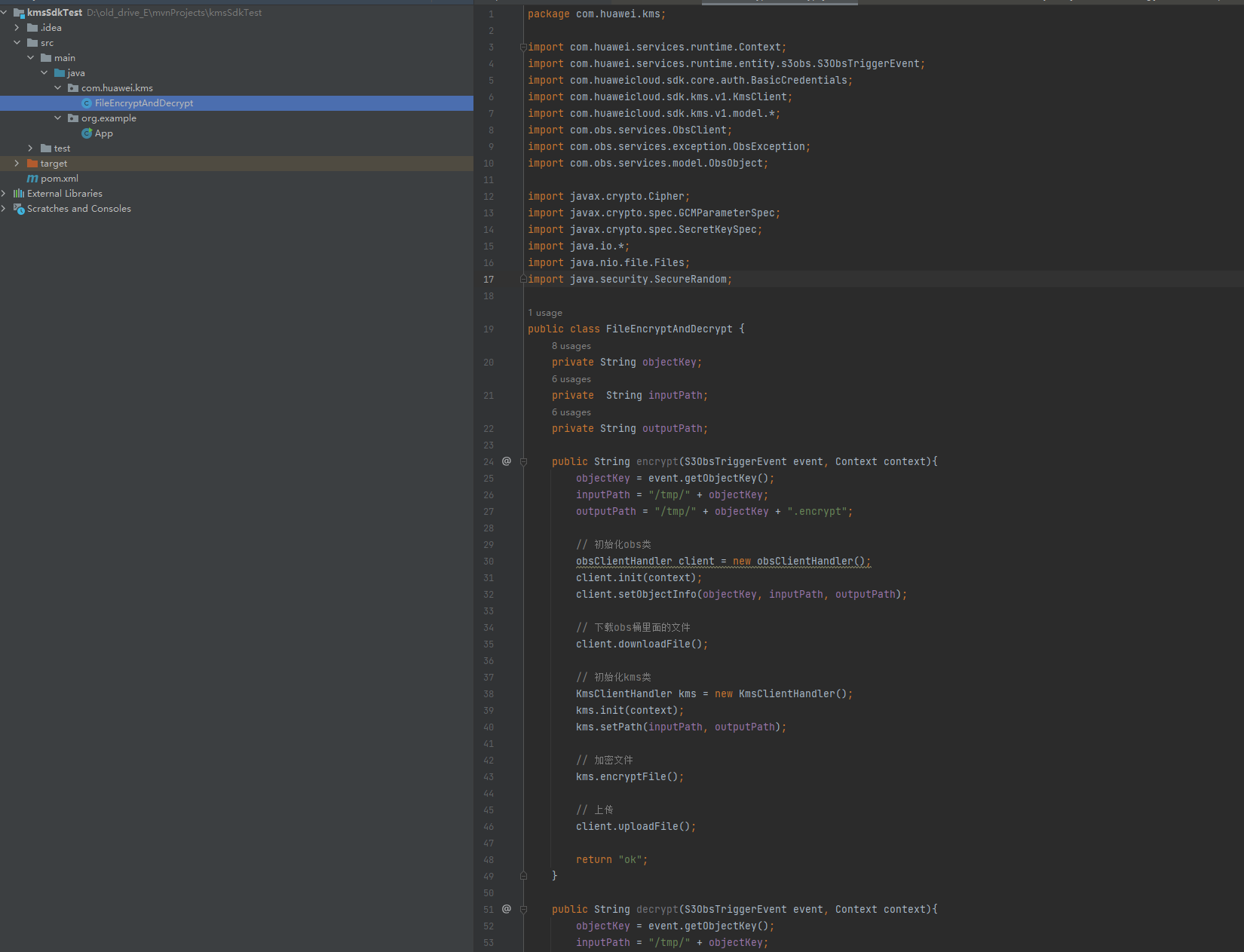
其中fileencryptanddecrypt为函数执行的入口类,fileencryptanddecrypt类中入口函数的代码如下:
package com.huawei.kms;
import com.huawei.services.runtime.context;
import com.huawei.services.runtime.entity.s3obs.s3obstriggerevent;
import com.huaweicloud.sdk.core.auth.basiccredentials;
import com.huaweicloud.sdk.kms.v1.kmsclient;
import com.huaweicloud.sdk.kms.v1.model.*;
import com.obs.services.obsclient;
import com.obs.services.exception.obsexception;
import com.obs.services.model.obsobject;
import javax.crypto.cipher;
import javax.crypto.spec.gcmparameterspec;
import javax.crypto.spec.secretkeyspec;
import java.io.*;
import java.nio.file.files;
import java.security.securerandom;
public class fileencryptanddecrypt {
    private string objectkey;
    private  string inputpath;
    private string outputpath;
    public string encrypt(s3obstriggerevent event, context context){
        objectkey = event.getobjectkey();
        inputpath = "/tmp/"   objectkey;
        outputpath = "/tmp/"   objectkey   ".encrypt";
        // 初始化obs类
        obsclienthandler client = new obsclienthandler();
        client.init(context);
        client.setobjectinfo(objectkey, inputpath, outputpath);
        // 下载obs桶里面的文件
        client.downloadfile();
        // 初始化kms类
        kmsclienthandler kms = new kmsclienthandler();
        kms.init(context);
        kms.setpath(inputpath, outputpath);
        // 加密文件
        kms.encryptfile();
        // 上传
        client.uploadfile();
        return "ok";
    }
    public string decrypt(s3obstriggerevent event, context context){
        objectkey = event.getobjectkey();
        inputpath = "/tmp/"   objectkey;
        outputpath = "/tmp/"   objectkey   ".decrypt";
        // 初始化obs类
        obsclienthandler client = new obsclienthandler();
        client.init(context);
        client.setobjectinfo(objectkey, inputpath, outputpath);
        // 下载obs桶里面的文件
        client.downloadfile();
        // 初始化kms类
        kmsclienthandler kms = new kmsclienthandler();
        kms.init(context);
        kms.setpath(inputpath, outputpath);
        // 加密文件
        kms.decryptfile();
        // 上传
        client.uploadfile();
        return "ok";
    }
    static class kmsclienthandler {
        // dew服务接口版本信息,当前固定为v1.0
        private static final string kms_interface_version = "v1.0";
        private static final string aes_key_bit_length = "256";
        private static final string aes_key_byte_length = "32";
        private static final string aes_alg = "aes/gcm/pkcs5padding";
        private static final string aes_flag = "aes";
        private static final int gcm_tag_length = 16;
        private static final int gcm_iv_length = 12;
        private string access_key;
        private string secret_access_key;
        private string security_token;
        private string project_id;
        private string kms_endpoint;
        private string keyid;
        private string ciphertext;
        private string inputpath;
        private string outputpath;
        private context context;
        private kmsclient kmsclient = null;
        void init(context context) {
            this.context = context;
        }
        void initkmsclient() {
            if (kmsclient == null) {
                access_key = context.getsecurityaccesskey();
                secret_access_key = context.securitygetsecretkey();
                security_token = context.getsecuritytoken();
                project_id = context.getprojectid();
                kms_endpoint = context.getuserdata("kms_endpoint");
                keyid = context.getuserdata("kms_key_id");
                ciphertext = context.getuserdata("cipher_text");
                final basiccredentials auth = new basiccredentials().withak(access_key).withsk(secret_access_key).withsecuritytoken(security_token).withprojectid(project_id);
                kmsclient = kmsclient.newbuilder().withcredential(auth).withendpoint(kms_endpoint).build();
            }
        }
        byte[] getencryptplainkey() {
            final createdatakeyrequest createdatakeyrequest = new createdatakeyrequest().withversionid(kms_interface_version)
                    .withbody(new createdatakeyrequestbody().withkeyid(keyid).withdatakeylength(aes_key_bit_length));
            final createdatakeyresponse createdatakeyresponse = kmsclient.createdatakey(createdatakeyrequest);
            final string ciphertext = createdatakeyresponse.getciphertext();
            return hextobytes(createdatakeyresponse.getplaintext());
        }
        byte[] hextobytes(string hexstring) {
            final int stringlength = hexstring.length();
            assert stringlength > 0;
            final byte[] result = new byte[stringlength / 2];
            int j = 0;
            for (int i = 0; i < stringlength; i  = 2) {
                result[j  ] = (byte) integer.parseint(hexstring.substring(i, i   2), 16);
            }
            return result;
        }
        public void setpath(string inputpath, string outputpath) {
            this.inputpath = inputpath;
            this.outputpath = outputpath;
        }
        public void  encryptfile() {
            final file outencryptfile = new file(outputpath);
            final file infile = new file(inputpath);
            final byte[] iv = new byte[gcm_iv_length];
            final securerandom securerandom = new securerandom();
            securerandom.nextbytes(iv);
            dofilefinal(cipher.encrypt_mode, infile, outencryptfile, getencryptplainkey(), iv);
        }
        byte[] getdecryptplainkey() {
final createdatakeyrequest createdatakeyrequest = new createdatakeyrequest().withversionid(kms_interface_version)
        .withbody(new createdatakeyrequestbody().withkeyid(keyid).withdatakeylength(aes_key_bit_length));
// 创建数据密钥
final createdatakeyresponse createdatakeyresponse = kmsclient.createdatakey(createdatakeyrequest);
            final decryptdatakeyrequest decryptdatakeyrequest  = new decryptdatakeyrequest().withversionid(kms_interface_version)
                    .withbody(new decryptdatakeyrequestbody().withkeyid(keyid).withciphertext(createdatakeyresponse.getciphertext()
).withdatakeycipherlength(aes_key_byte_length));
            return hextobytes(kmsclient.decryptdatakey(decryptdatakeyrequest).getdatakey());
        }
        public void  decryptfile() {
            final file outencryptfile = new file(outputpath);
            final file infile = new file(inputpath);
            final byte[] iv = new byte[gcm_iv_length];
            final securerandom securerandom = new securerandom();
            securerandom.nextbytes(iv);
            dofilefinal(cipher.decrypt_mode, infile, outencryptfile, getdecryptplainkey(), iv);
        }
        /**          //     * 对文件进行加解密          //     *          //     * @param ciphermode 加密模式,可选值为cipher.encrypt_mode或者cipher.decrypt_mode          //     * @param infile     加解密前的文件          //     * @param outfile    加解密后的文件          //     * @param keyplain   明文密钥          //     * @param iv         初始化向量          //     */         void dofilefinal(int ciphermode, file infile, file outfile, byte[] keyplain, byte[] iv) {
            try (bufferedinputstream bis = new bufferedinputstream(files.newinputstream(infile.topath()));
                 bufferedoutputstream bos = new bufferedoutputstream(files.newoutputstream(outfile.topath()))) {
                final byte[] bytin = new byte[(int) infile.length()];
                final int filelength = bis.read(bytin);
                assert filelength > 0;
                final secretkeyspec secretkeyspec = new secretkeyspec(keyplain, aes_flag);
                final cipher cipher = cipher.getinstance(aes_alg);
                final gcmparameterspec gcmparameterspec = new gcmparameterspec(gcm_tag_length * byte.size, iv);
                cipher.init(ciphermode, secretkeyspec, gcmparameterspec);
                final byte[] bytout = cipher.dofinal(bytin);
                bos.write(bytout);
            } catch (exception e) {
                throw new runtimeexception(e.getmessage());
            }
        }
    }
    static class obsclienthandler {
        private obsclient obsclient = null;
        private string inputbucketname;
        private string outputbucketname;
        private string objectkey;
        private context context;
        private string localinpath;
        private string localoutpath;
        public void init(context context) {
            this.context = context;
        }
        void initobsclient() {
            if (obsclient == null) {
                inputbucketname = context.getuserdata("input_bucket");
                outputbucketname = context.getuserdata("output_bucket");
                string security_access_key = context.getsecurityaccesskey();
                string security_secret_key = context.getsecuritysecretkey();
                string security_token = context.getsecuritytoken();
                string obs_endpoint = context.getuserdata("obs_endpoint");
                obsclient = new obsclient(security_access_key, security_secret_key, security_token, obs_endpoint);
            }
        }
        public  void setobjectinfo(string objectkey, string inpath, string outpath) {
            this.objectkey = objectkey;
            localinpath = inpath;
            localoutpath = outpath;
        }
        public void downloadfile() {
            initobsclient();
            try {
                obsobject obsobject = obsclient.getobject(inputbucketname, objectkey);
                inputstream inputstream = obsobject.getobjectcontent();
                byte[] b = new byte[1024];
                int len;
                fileoutputstream fileoutputstream = new fileoutputstream("/tmp/"   objectkey);
                while ((len = inputstream.read(b)) != -1) {
                    fileoutputstream.write(b);
                }
                inputstream.close();
                fileoutputstream.close();
            } catch (obsexception ex) {
                ex.printstacktrace();
            } catch (ioexception e) {
                throw new runtimeexception(e);
            }
        }
        public void uploadfile() {
            try {
                // 待上传的本地文件路径,需要指定到具体的文件名
                fileinputstream fis = new fileinputstream(new file("/tmp/"   objectkey   ".encrypt"));
                obsclient.putobject(outputbucketname, objectkey, fis);
                fis.close();
            } catch (filenotfoundexception e) {
                throw new runtimeexception(e);
            } catch (ioexception e) {
                throw new runtimeexception(e);
            }
        }
    }
}
创建函数
创建函数的时候,必须选择委托包含obs和dew访问权限的委托,否则不能使用obs和dew服务。
- 登录,在左侧导航栏选择“函数 > 函数列表”,进入函数列表界面。
- 单击“创建函数”,进入创建函数流程。
- 选择“创建空白函数”,填写函数配置信息。
输入基础配置信息,完成后单击“创建函数”。
- 函数类型:事件函数。
- 函数名称:输入您自定义的函数名称,此处以“fss_examples_dew”为例。
- 委托名称:选择创建委托中创建的“serverless_trust”。
- 运行时语言:选择“java8”。
- 进入fss_examples_dew函数详情页,配置如下信息。
- 在“代码”页签,代码选择“上传自jar文件”,上传样例代码编译后的jar包,上传成功后单击“确定”。
- 在“设置 > 常规设置”页签,设置如下信息,完成后单击“保存”。
- 内存:选择“128”
- 执行超时时间:输入“3”
- 函数执行入口:默认“com.huawei.kms.fileencryptanddecrypt.encrypt”
- 所属应用:默认“default”
- 描述:输入“文件加解密”
- 在“设置 > 环境变量”页签,输入环境信息,完成后单击“保存”。
dew_endpoint:dew服务的endpoint地址
dew_key_id:用户主密钥id。
input_bucket: 输入文件对应的obs桶。
output_bucket: 加解密后上传的obs桶。
obs_endpoint: obs服务对应的endpoint。
表1 环境变量 环境变量
说明
dew_endpoint
dew服务终端节点,获取地址请参考。
dew_key_id
用户主密钥id。
input_bucket
存放输入文件的obs桶。
output_bucket
存放加密后上传文件的obs桶。
obs_endpoint
obs服务终端节点,获取地址请参考。
相关文档
意见反馈
文档内容是否对您有帮助?
提交成功!非常感谢您的反馈,我们会继续努力做到更好!
您可在查看反馈及问题处理状态。
系统繁忙,请稍后重试
如您有其它疑问,您也可以通过华为云社区问答频道来与我们联系探讨


